
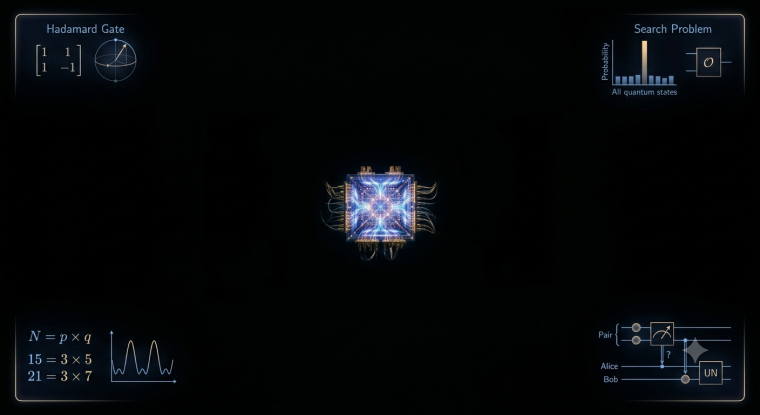
A month ago, I finished reading Quantum Computing: From Alice to Bob (Alice Flarend and Robert Hilborn, Oxford University Press), an excellent introduction to the world of quantum computing.
My interest in quantum physics goes back to my student years, when a remarkable documentary on the physics of the infinitely small sparked my curiosity. It nurtured in me a fascination for this new field I was discovering: uncertainty, the impossible becoming possible at small scale. I had especially enjoyed the illustrations of how reality is relative to the observer.
Later, during my years in cybersecurity and blockchain, I was led to reconsider quantum computing once again: quantum computers are, after all, expected to be far more capable at breaking encryption technologies that we consider the most secure today. That curiosity pushed me to go beyond my amateur knowledge of quantum physics and look into quantum computing proper.
Why an engineer should understand the fundamentals
After this read, I came to understand that it is important for any engineer or computer-science researcher to master the basics of quantum computing, for two reasons:
- knowing nothing about it, and therefore lacking sound judgment on the subject;
- having only scattered knowledge, picked up here and there (AI included), and struggling to truly innovate in the field.
Quantum computers offer great opportunities on certain specific problems, but amateurs are often too quick to announce all the fantasies drawn from movies or marketing pitches.
For an engineer, knowing the tools you use is essential. I have, for instance, a deep grasp of the mathematics applied to computing — binary, Boolean logic, then discrete mathematics — which underpin all the tools we work with daily. Quantum computing deserves the same rigor.
In this book, I (re)discovered clearly explained qubits, the construction of gates such as the CNOT and the Hadamard gate, as well as the concepts of superposition and entanglement, among many other notions worth knowing.
The urgency of post-quantum cryptography
This is probably the most concrete near-term challenge. In August 2024, NIST finalized its first post-quantum cryptography standards, and the official timelines are becoming clearer: according to NIST, algorithms such as RSA-2048 and elliptic curves (ECC) are to be deprecated by 2030 and fully phased out by 2035; the NSA’s CNSA 2.0 suite likewise targets a complete migration of national security systems by 2035. We can therefore expect rapid adoption of the post-quantum algorithms already available.
It is important, however, to distinguish between several families that are often conflated:
- Kyber, now standardized as ML-KEM (FIPS 203), is a post-quantum key encapsulation mechanism;
- SHA-3 is a hash function; on its own it is not “post-quantum encryption,” but robust hash functions serve as the basis for hash-based signatures and remain quantum-resistant;
- STARKs are zero-knowledge proof systems that rely precisely on hashing, and are therefore also considered post-quantum.
Why the urgency? Because Shor’s algorithm can efficiently solve the problem of factoring large numbers (and the discrete logarithm problem). And it is precisely these problems — believed to be very hard for a classical computer — that guarantee the security of asymmetric (public-key) cryptography such as RSA or ECC: the whole difficulty lies in recovering the private key from the public key. A sufficiently powerful quantum computer would make that task feasible.
An important and often misunderstood point: Shor breaks asymmetric cryptography, not symmetric cryptography. Symmetric encryption (AES, for example) is only moderately weakened by Grover’s algorithm, and simply doubling the key size — hence the recommendation of AES-256 — is enough to guard against it. So for an engineer who wants to improve or implement these algorithms, understanding the foundations of quantum computing is not a luxury.
An opportunity for consensus algorithms
The no-cloning theorem — the impossibility of copying an unknown quantum state — seems to me to open a real opportunity for consensus algorithms.
In recent years, I have worked on SoloSafe, a system for transferring assets offline, without relying on consensus among participants the way today’s blockchains do. Currently, blockchains establish trust by guaranteeing the credibility of transactions through consensus algorithms (BFT, Hashgraph, etc.). Yet these mechanisms do not allow you, for instance, to send money from one phone to another as easily as sending a photo via AirDrop: you always need a central server or decentralized nodes to attest to the existence and ownership of the assets.
The no-cloning of qubits changes the game: since a quantum state cannot be duplicated, it becomes conceivable to design “tokens” that are impossible to spend twice, and therefore highly secure trust mechanisms operating directly on the edge, without a trusted third party.
This idea is not, in fact, new in theory: it is the concept of quantum money, proposed by Stephen Wiesner as far back as the late 1960s. The main obstacle today remains practical — quantum states decohere very quickly and are difficult to store or transmit — but that is precisely where, to my mind, some promising research directions lie.
Continuing to learn
Quantum computing offers a great deal of opportunity, and now is the right time to embrace it fully, whether in learning or in research. For my part, I am pursuing new courses on Coursera, learning Qiskit, and continuing to explore the mathematical structures that will remain, I am convinced, fascinating and useful in the years to come.
An opportunity for the DR Congo 🇨🇩 and investors: Mbuji-Mayi, the quantum city

As a Congolese, I cannot overlook a dimension that directly concerns my country. The DR Congo is rich in raw materials and is now drawing the attention of many nations for its minerals that are strategic to the ecological transition and to 21st-century technologies: cobalt, copper, uranium, and more.
In its final chapter, the book discusses certain materials useful for building quantum computers. Indeed, several companies and start-ups are currently exploring different approaches: trapped ions, NV centers (nitrogen vacancies) in diamond, photonic qubits, neutral atoms, quantum dots, and topological qubits. All of these processes rely on raw materials. If diamond, for example, were to confirm its potential, it would represent an immense advantage for the Kasaï region, which is rich in diamond — much as cobalt has boosted Kolwezi. Other materials also come into play, such as selenium and cadmium (cadmium selenide is used in some quantum dots), along with various semiconductors.
We must keep investing in the technologies of the future — not to be at the mercy of tomorrow’s markets, but to be players in them.
